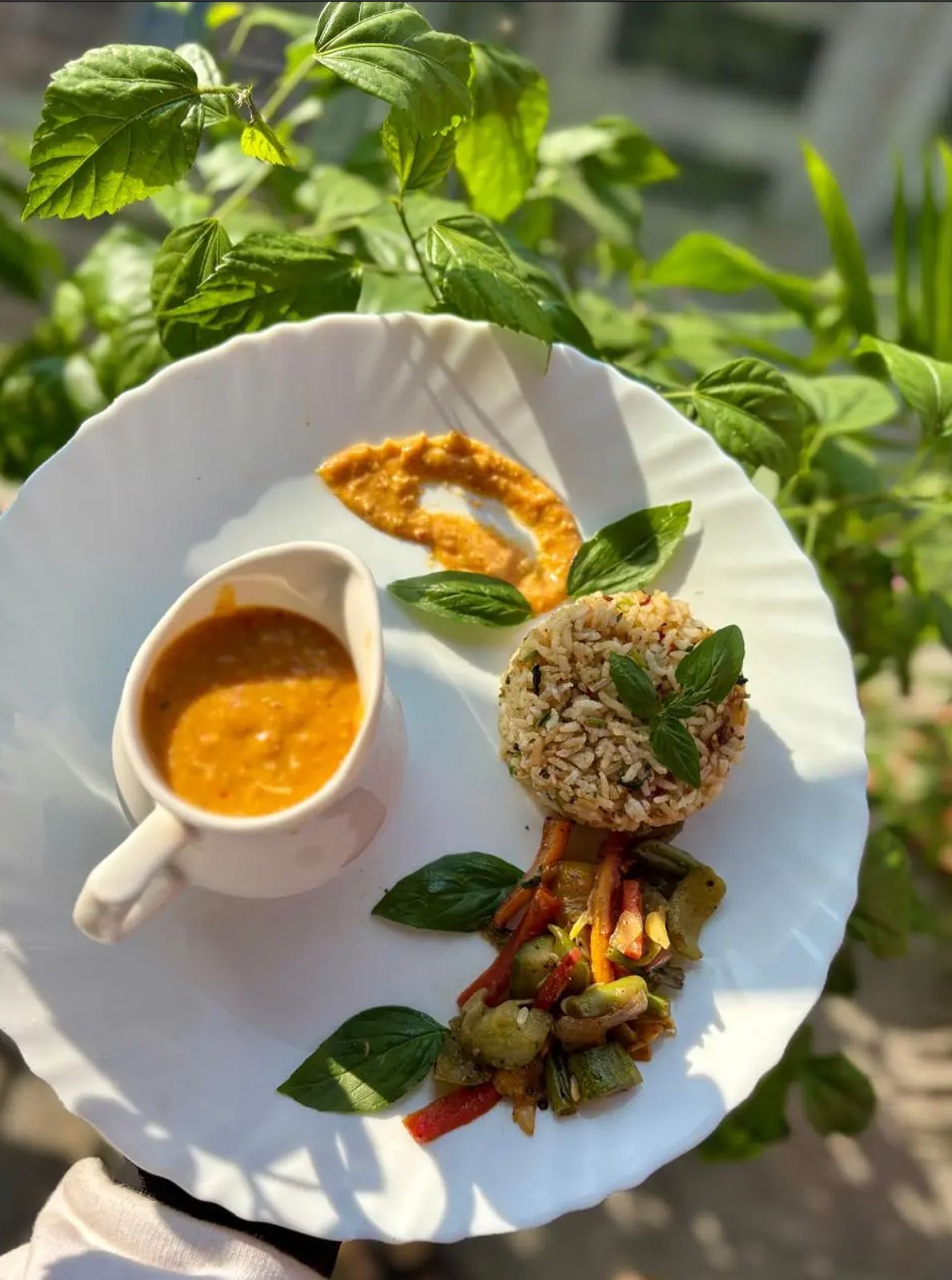
At Calizz, breakfast becomes your first glimpse into Goa’s soul; offering flavours shaped by centuries of tradition. We offer four distinct breakfast experiences: the local Tribal breakfast, the Goan Satwik Saraswat breakfast, the Portuguese breakfast, and a fully customised breakfast tailored to your preferences. Each reflects a different thread of Goa’s identity, mirroring traditions still cherished in Goan homes today. Our Portuguese breakfast, in particular, is an immersion into flavours shaped by centuries of cultural exchange — from artisanal pao and fragrant Goan xacuti to classic bacalhau, apas de camarão, and several heirloom preparations that require days of advance work. With prior notice, even these slow-crafted dishes are lovingly made for you. Through these menus, we invite you to experience the Goa that existed before 1961, intimate, storied, and deeply connected to its past, before continuing into the larger narrative that follows.
The History Behind The Portuguese Cuisine in Goa
For those who explore the history of world cuisines, it is well understood that Portugal, more specifically the vast reach of Portuguese exploration, played an extraordinary role in shaping some of the world’s most iconic food cultures. Portuguese cooking itself didn’t radically transform the culinary habits of distant lands; instead, Portuguese trade routes became the channels through which ingredients travelled across continents, transforming local cuisines forever. Nowhere is this influence more profound than in the Indian subcontinent. It is difficult to even imagine Indian cooking today without tomatoes, potatoes, peanuts, cashews, guavas, corn, pumpkin, and above all chilies. These staples, now inseparable from Indian identity, were once foreign ingredients from America, introduced to India primarily through Goa, the Portuguese gateway to the East.
This exchange of food and ideas was never simple or one-sided. While Portuguese ships carried ingredients to India, they also absorbed native tastes, techniques, and preferences, giving rise to a rich, multi-layered cultural blending that unfolded over centuries of complex, sometimes harsh, colonial history. Indian kitchens had long perfected the art of seasoning and spice, but it was only after the Portuguese arrival in the 1500s that the fiery heat of chilies became part of everyday cooking much like Italy’s love affair with tomatoes began only after the 16th century.
As Portuguese settlements flourished in Goa, other European powers were carving up their own spheres of influence, each contributing to a growing, interconnected world. Of all the exchanges taking place, the movement of ingredients proved the most transformative. The Portuguese introduction of potatoes, tomatoes, chilies, corn, peanuts, cashews, guavas, papaya, peppers, and squash reshaped Indian markets and households forever. Many of these ingredients were originally sourced by Spanish conquistadors in Mesoamerica, then traded or transferred to the Portuguese, who carried them across the oceans into Goa, where they naturally entered local diets, farming cycles, and culinary imagination.
The introduction of vinegar marked another quiet revolution. Hindus and Muslims traditionally avoided cooking with vinegar due to its alcoholic origins; instead, they relied on tamarind, kokum, lemon, raw mango, or bilimbi for acidity. But with the arrival of Portuguese palm vinegar, Goa discovered entirely new possibilities like pickles, dressings, chutneys, and curries that carried a depth previously unknown. This transformation illustrates an important truth: no cuisine is ever truly “authentic” or frozen in time. Culinary identity evolves constantly, shaped by geography, trade, migration, climate, and taste.
Even as the Portuguese imposed aspects of their culture with lasting impact on architecture, aesthetics, and religious practice, food proved more resistant to outright adoption. Instead, Portuguese settlers recreated their home dishes with what was available; Goans, intrigued, adapted those recipes to their own beloved flavours and techniques. The result was not Portuguese food, nor Goan food as it had been before, but an exquisite fusion, the birth of Goan Catholic cuisine.
One of the biggest shifts brought by the Portuguese was the widespread consumption of meat. As many Goans converted to Christianity during Portuguese rule, they adopted ingredients previously unfamiliar to the predominantly Hindu population especially pork, including offal and even blood. This gave rise to dishes like sorpotel (from the Alentejan dish sarapatel), which transformed dramatically when cooked with local spices, palm vinegar, and heat. Portuguese food-preservation techniques also took root. Para, the Goan pickled fish, echoes the Iberian escabeche, itself a Moorish inheritance that later inspired Japan’s nanban-zuke. Goan sausage, or chouriço/chorise, descended from Portuguese chouriço but evolved into a spicier, tangier, distinctly Goan delight.
Bread too changed forever. Pav the soft, yeasted pão the Portuguese baked became an everyday staple in Goa and later in Bombay, where pav bhaji and vada pav became icons of Indian street food. In Goa, pav sometimes even replaced rice, carving its own beloved place in local life.
Several classic Goan dishes today owe their identity to this cultural fusion. Vindaloo, perhaps the most famous, began as the Portuguese vinha d’alhos, a marinade of wine and garlic. In Goa, wine was replaced by palm vinegar, spices were added both for flavour and preservation, and the dish evolved into a fiery curry beloved around the world. Visit Madeira or Lisbon today and you can still taste carne de vinha d’alhos and recognise the ancestral note in a Goan vindaloo.
Desserts, too, tell stories across oceans. Bebinca, now cherished in Goa and in Goan restaurants in Lisbon, was created by a nun named Bebiana, inspired by Lisbon’s seven hills. Using coconut milk and coconut in place of Portuguese almonds and cow’s milk, she created a layered sweet that mirrored the geography of both lands. Though traditionally seven layers, modern versions can have up to sixteen.
Wine-making also arrived with the Portuguese. Today, Goa remains a centre for Indian wine production, its climate and terrain well-suited to vineyards. Even fortified wines reminiscent of Port are produced, echoing an old European habit the settlers never abandoned.
Xacuti (chacuti) is another fascinating example. Filled with spices, coconut, chilies, nutmeg, and cardamom, it feels unmistakably Indian. Yet its evolution is tied to Portuguese rule, particularly the use of meats that Hindu Goans would not have traditionally consumed. Hence, chacuti stands at the crossroads of Goan and Portuguese heritage, born in Goa but shaped by the era’s cultural dynamics. Similarly, dishes like recheado named after the Portuguese word for “stuffed” reveal the linguistic and culinary imprints still alive in Goan kitchens today.
Together, these exchanges created a culinary identity unlike any other in the world, one shaped by oceans, empires, trade winds, ancient spices, indigenous tradition, and colonial influence. Goan food today carries echoes of its past in every bite: the Americas in a chili, Portugal in a pickle, India in the spices that warm the soul, and Goa itself in the harmony that binds them all.